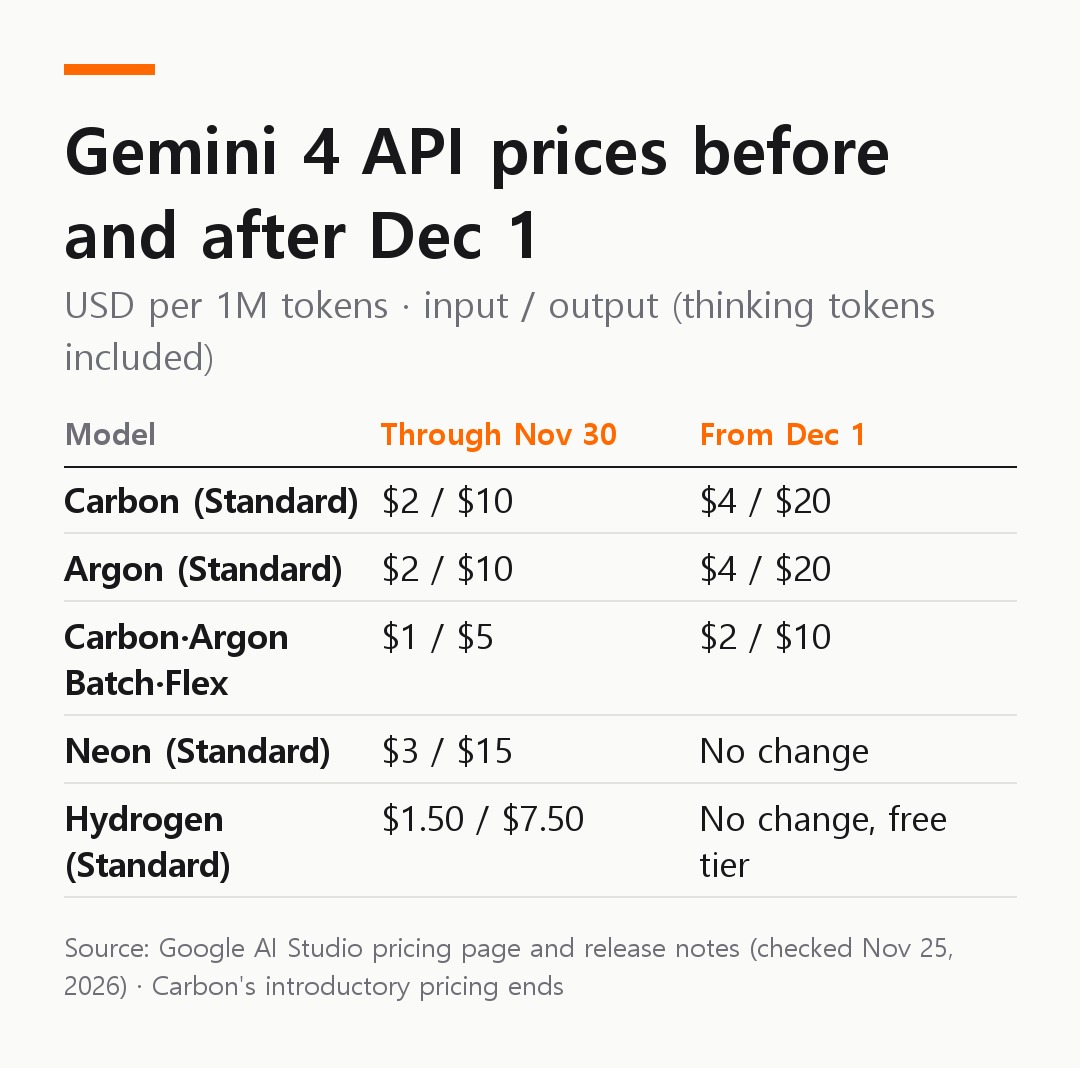
If you call Gemini 4 Carbon or Gemini 4 Argon through the Gemini API, your per-token bill doubles on December 1, 2026. Input goes from $2 to $4 per million tokens and output from $10 to $20. This is not a surprise price hike: Google launched Carbon on November 10 with “introductory pricing” that was always set to end on November 30. We opened the official Google AI Studio pricing page, the Gemini API release notes and the Argon migration guide on November 25, 2026, and every number below comes from those pages or from our own arithmetic on them.
One thing to clear up first: this is about the developer API, billed per token through Google AI Studio or Google Cloud. It has nothing to do with the Gemini app subscriptions (free, Google AI Pro, Ultra). If you only chat with Gemini in the app, nothing changes for you.
What the official pages actually say
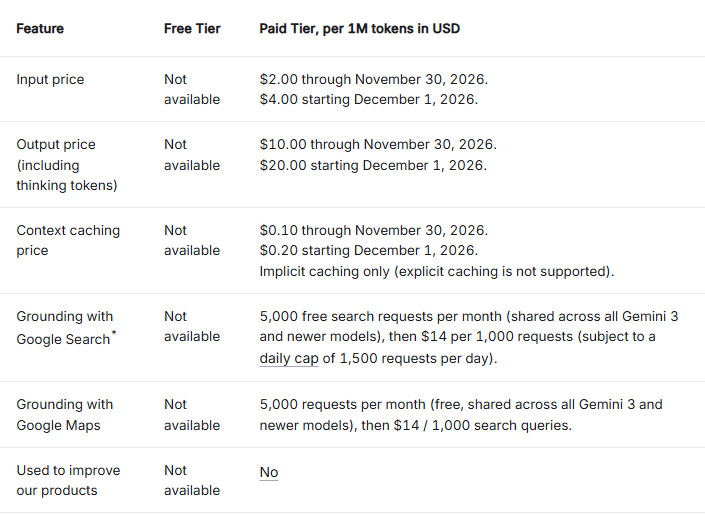
The November 10, 2026 entry in the Gemini API release notes announces Carbon as generally available “at introductory pricing of $2.00 per 1M input tokens and $10.00 per 1M output tokens through November 30, 2026.” The pricing page now lists two lines for every Carbon and Argon price: one valid through November 30 and one “starting December 1, 2026.” Carbon and Argon are the only Gemini 4 models with this date split; Argon, released earlier on October 13, moves to the same new prices on the same day.

Here is the Carbon paid-tier table as it appeared on November 25. Input, output and context caching all double. Carbon is not available on the free tier at all.
Full price table, every mode
Prices are in US dollars per one million tokens, shown as input / output. Output includes thinking tokens, which the model spends before it answers.
| Model and mode | Through Nov 30 | From Dec 1 |
|---|---|---|
| Carbon / Argon, Standard | $2 / $10 (cache $0.10) | $4 / $20 (cache $0.20) |
| Carbon / Argon, Batch and Flex | $1 / $5 | $2 / $10 |
| Carbon / Argon, Priority | $3.60 / $18 | $7.20 / $36 |
| Neon, Standard | $3 / $15 | No change announced |
| Neon, Batch and Flex | $1.50 / $7.50 | No change announced |
| Hydrogen, Standard | $1.50 / $7.50 (free tier available) | No change announced |
| Hydrogen, Batch and Flex | $0.75 / $3.75 | No change announced |
Batch and Flex are half price because they are slower. Google’s Flex inference page gives a target latency of 1 to 15 minutes for Flex and up to 24 hours for Batch, and says Flex requests “may be preempted or evicted” when standard traffic spikes. Argon and Hydrogen also show an invite-only “Contributor” tier at lower prices, where the pricing table marks your data as used to improve Google’s products.
Grounding with Google Search and Google Maps is unchanged: 5,000 free requests per month shared across Gemini 3 and newer models, then $14 per 1,000.
Carbon vs Argon: same price, different token use
Argon became generally available on October 13, 2026. Google’s “What’s new in Gemini 4 Argon” guide says the two models “share the same 1M unified context window, built-in tools, and per-token pricing,” and that the main difference is how many thinking tokens each spends per turn. Carbon thinks longer and verifies its work, which costs more tokens and time. Argon answers faster with fewer thinking tokens and defaults to the medium thinking level.
So even though the per-token rate is identical after December 1, the same job will usually cost less on Argon simply because it produces fewer output tokens. Google does not publish a ratio, so we are not going to invent one. If you want a number for your own workload, run the same prompts through both models and compare the usage metadata.
What a monthly bill looks like
To make the change concrete, we assumed a workload of 40 million input tokens, 10 million cached tokens and 5 million output tokens per month, and multiplied by the official prices. Carbon or Argon on Standard goes from $131 to $262. The interesting line is Batch and Flex: from December they cost exactly what Standard costs today, so moving non-urgent work to batch keeps your bill flat.
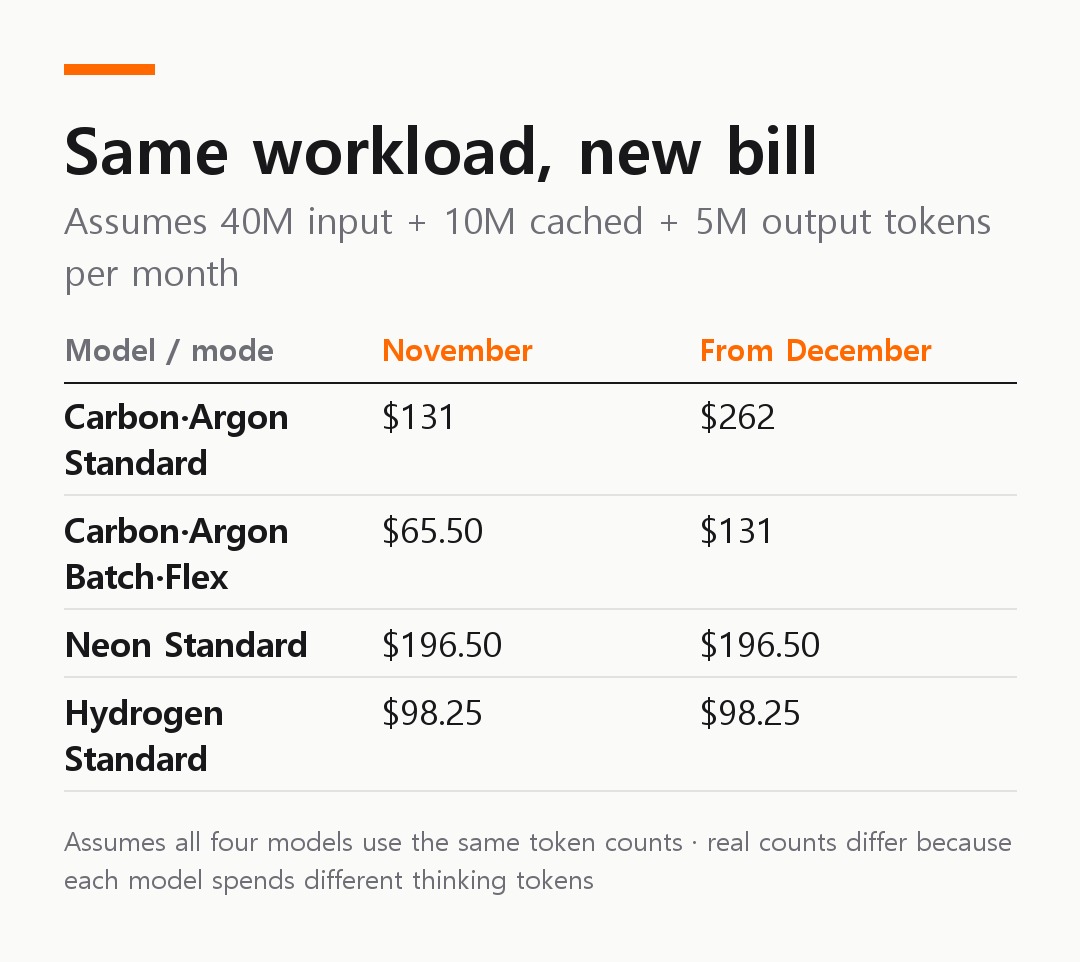
Real bills will differ. The table assumes every model uses exactly the same number of tokens, which is not how it works in practice: each model spends a different amount of thinking tokens on the same job, and thinking tokens are billed at the output rate. Treat the table as a way to see the price ratio between models, not as a quote.
The models that are not changing
Gemini 4 Neon (released November 18) stays at $3 / $15, and Gemini 4 Hydrogen (released November 12) stays at $1.50 / $7.50. After December 1, Neon’s per-token price is 25% lower than Carbon and Argon on both input and output, and Hydrogen’s is 62.5% lower.
That does not mean a task will cost 25% or 62.5% less. The default thinking levels differ: Carbon and Argon default to medium and cap at high, while Neon and Hydrogen default to high and support xhigh. Left on defaults, Neon and Hydrogen may spend more thinking tokens per request, so compare them on your own prompts before switching.
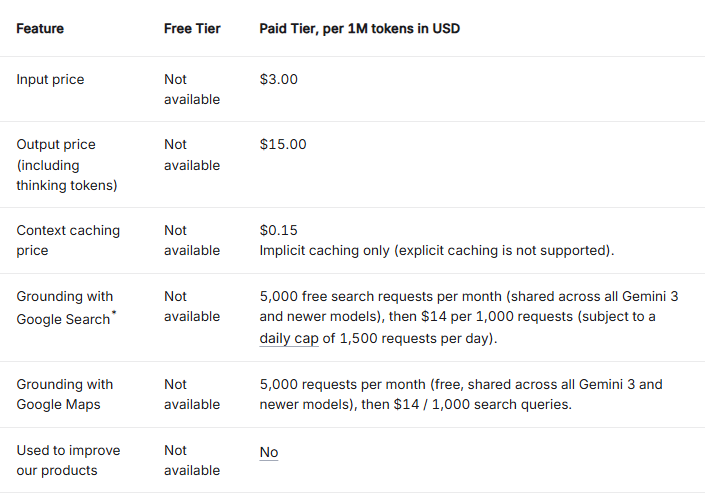
Hydrogen is the only Gemini 4 model with a free tier. The pricing page states that free-tier content is used to improve Google’s products, while paid-tier content is not. If your prompts contain anything you would not want used that way, stay on the paid tier.
A caching detail that matters more now
Every Gemini 4 model’s pricing row carries the same note: “Implicit caching only (explicit caching is not supported).” You cannot create a cache yourself and pin a long document to it; the API decides when cached pricing applies. According to the model guides, implicit caching is on by default for prompts of at least 4,096 tokens. From December 1, cached input on Carbon and Argon costs $0.20 per million tokens and uncached input costs $4, so for workloads that resend the same long context, how often the cache actually hits matters more to the bill than the doubling itself.
A checklist before December 1
- Search your code and config for
gemini-4-carbonandgemini-4-argon. Any call from December 1 uses the new rates. - Set a project spend cap on the Google AI Studio Spend page. Google’s billing docs label this feature experimental: there is a latency of around 10 minutes during which you can go over the cap, and long-running work such as batch jobs may also exceed it.
- Test lower thinking levels. Google’s Argon guide recommends running your evaluation at low, medium and high and picking the lowest level that meets your quality bar.
- Move anything that can wait to the Batch API, which stays at half the Standard price.
- If quality allows, compare Neon or Hydrogen on your own prompts before switching.
How we checked
We only report what we could see on official pages and what follows from simple arithmetic. On November 25, 2026 we opened the Google AI Studio pricing page (all four modes: Standard, Batch, Flex and Priority), the Gemini API release notes, the Carbon, Argon, Neon and Hydrogen guides, and the billing and Flex inference docs, captured the relevant tables, and kept dated text copies for later comparison. We did not convert prices to other currencies.
Official sources: Gemini Developer API pricing · Gemini API release notes · What’s new in Gemini 4 Argon
Leave a Reply