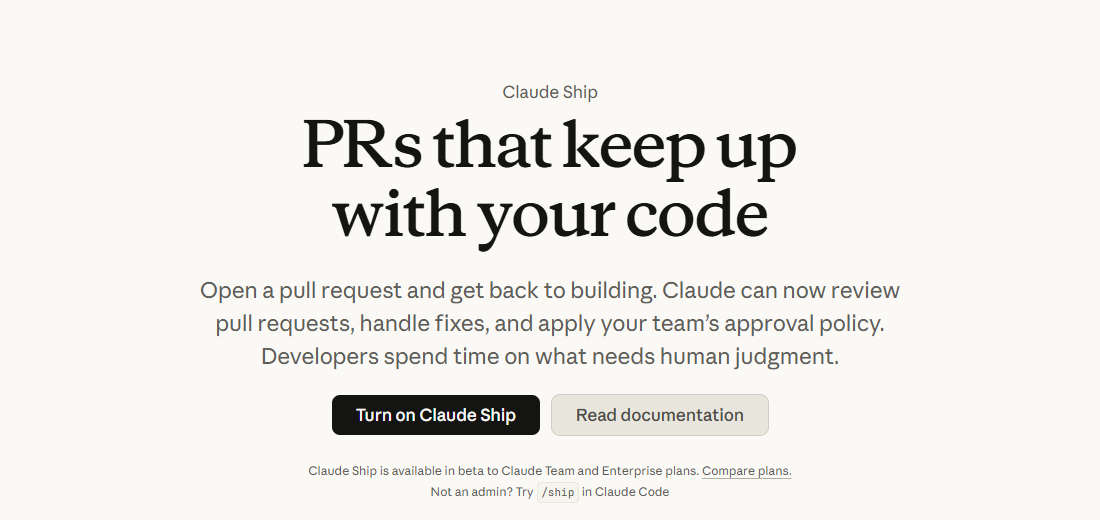
Claude Ship is Anthropic’s new set of agents for the part of software work that comes after you open a pull request: review, fixes, and the decision about whether a change is ready to merge. It launched in beta on November 23, 2026. Teams on Claude Team and Enterprise plans can turn it on per GitHub repository, and individual developers can get the review-and-fix part of that flow on their own pull requests with a new /ship command in Claude Code (without the Claude Approvals step). We read Anthropic’s announcement, the product page and the Claude Code documentation on November 25, 2026. We have not run it ourselves yet, so this guide sticks to what the official pages say, including the limits that are easy to miss.
What Claude Ship is made of
Claude Ship combines one agent that was already generally available with two new ones in beta. Anthropic’s framing is that a lot of code is now written by agents, so the steps after the PR need to move at the same speed, while teams decide where Claude runs and which changes still need a person.
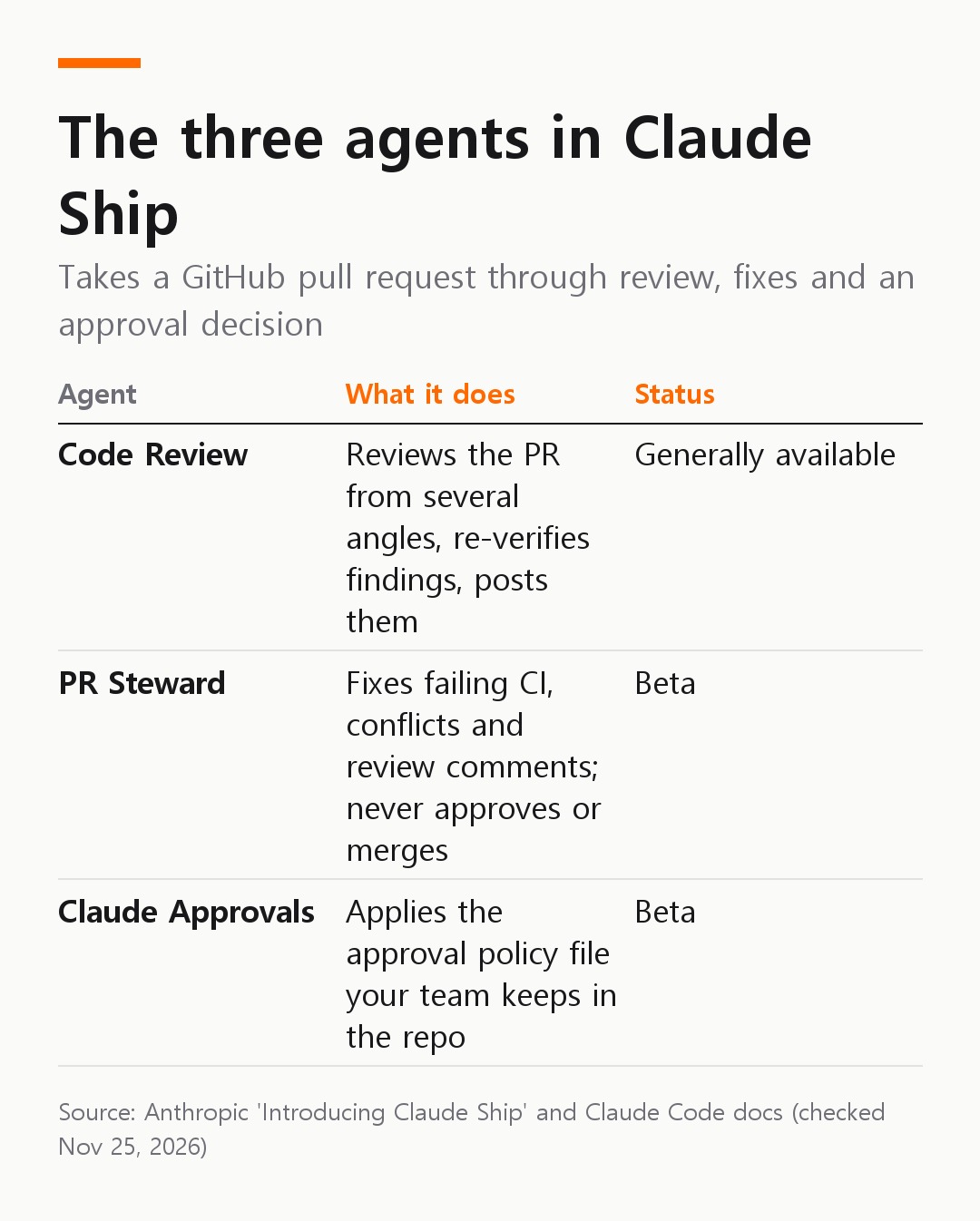
- Code Review (generally available) reviews a pull request against the codebase “through multiple lenses,” adversarially verifies its findings, categorizes them and posts them to the PR. Each repository can use Quick, Standard or Deep review levels.
- PR Steward (beta) works to keep a PR green. It picks up failing CI checks, merge conflicts and review feedback from Code Review, other tools or teammates, and pushes fixes. It is designed not to approve or merge. After every push it comments with what it changed and how to undo it. You can steer it by commenting
@claudewith an instruction, or stop it with@claude stop. - Claude Approvals (beta) applies an approval policy that your team writes as a file in the repository. Anthropic calls it “a smarter CODEOWNERS file.” The policy can let Claude approve routine changes or require human sign-off for certain paths or scenarios.
Option 1: /ship in Claude Code (for individual developers)
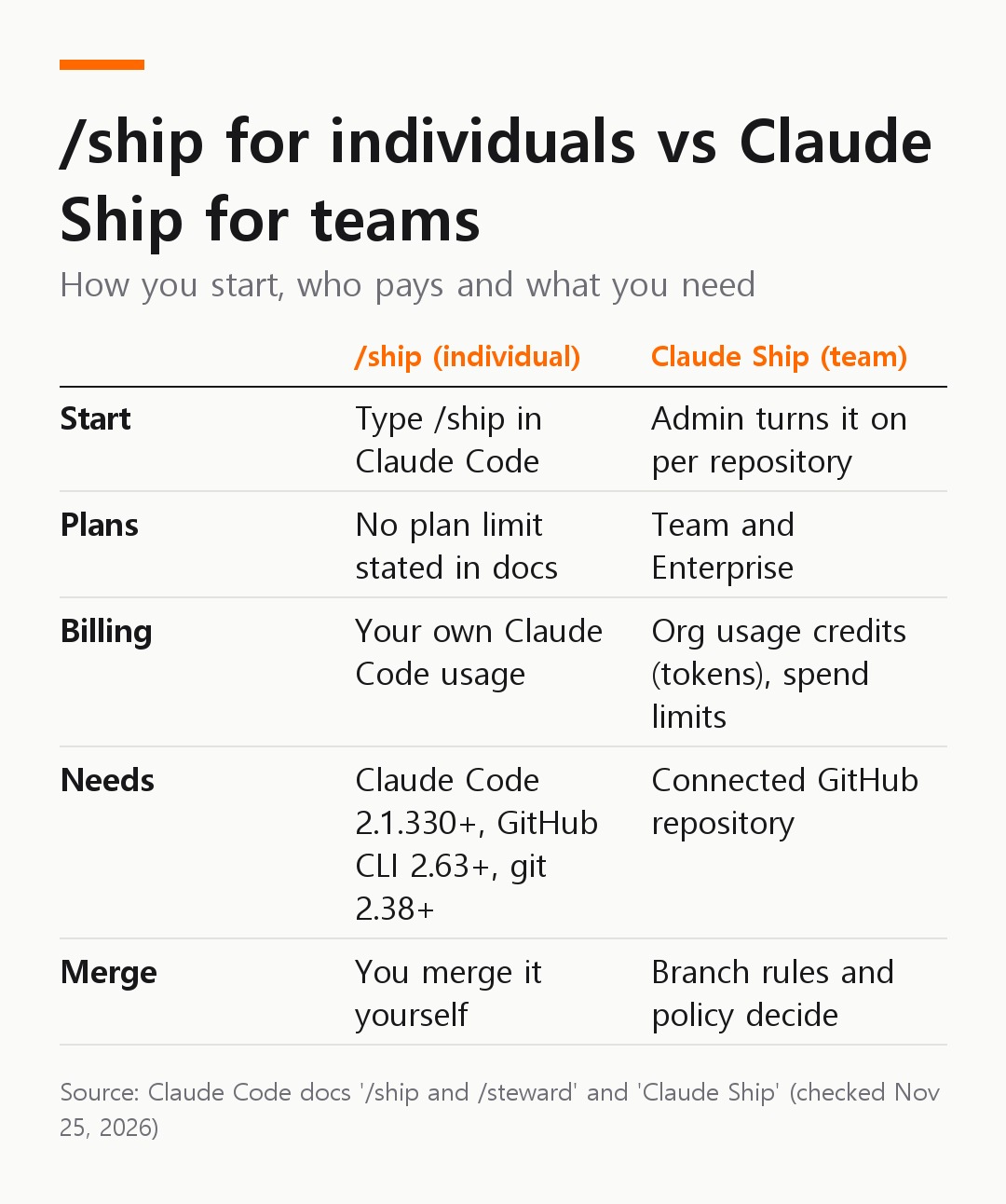
You do not need to be an admin. The product page itself says “Not an admin? Try /ship in Claude Code.” Note that /ship covers review and fixes only; the policy-based approval decision (Claude Approvals) is part of the team setup, not the command. When your change is finished, type /ship at the Claude Code prompt in your local clone. According to the docs, it then:
- Commits your work, pushes your branch and opens the pull request as you, if the branch does not have one yet.
- Reviews the change with
/code-review(default effort high; you can passlow,medium,xhighormax). - Starts a “watch”: Claude keeps checking the PR from your session and pushes fixes for failing checks, merge conflicts, reviewer comments and its own review findings.
- Leaves the merge to you.
If your PR is already open and you do not want a review first, use /steward instead, which skips straight to the watch. Type /ship stop to end a watch. Both commands run in your own session, so their work counts against your Claude Code usage.
Requirements: Claude Code 2.1.330 or later, the GitHub CLI 2.63 or later signed in with gh auth login, and git 2.38 or later. The /ship docs describe running the commands from the Claude Code CLI in a terminal, and cloud sessions do not have them. The announcement adds that /ship is rolling out in Claude Code and the desktop app. If /ship is missing, the troubleshooting page suggests running claude update and restarting Claude Code, sometimes twice.
Option 2: Claude Ship for a whole repository (admins)
Organizations on Claude Team or Enterprise can turn Claude Ship on for GitHub repositories so it runs on every pull request without anyone typing /ship. An admin enables Code Review and PR Steward per repository and chooses the review level, when reviews run and spend limits. The docs warn that PR Steward has no spend limit of its own until you set one, and that turning off usage credits in Organization settings does not stop an agent that is already on; it keeps running and billing until you turn Claude Ship off. Claude Approvals starts when a connected repository has a policy file on its default branch, and an admin can turn it off. It works alongside existing branch protection and required checks.
Billing. Each agent is billed on token usage through the organization’s usage credits, separately from the plan’s included usage. Claude Approvals has no base charge, but classifiers inside a policy are billed, and a policy that asks for Claude’s review triggers a billed Code Review even in observe mode. Anthropic recommends running Approvals in observe-only mode first and only later making its check required in branch protection.
Who cannot use it. Claude Ship is not available to organizations with Zero Data Retention, the HIPAA configuration, or customer-managed encryption keys. Eligible Enterprise organizations can claim at least $10,000 in Claude Ship credits by January 15, 2027, to be used within 30 days of claiming (terms apply).
Five things to check before you run /ship
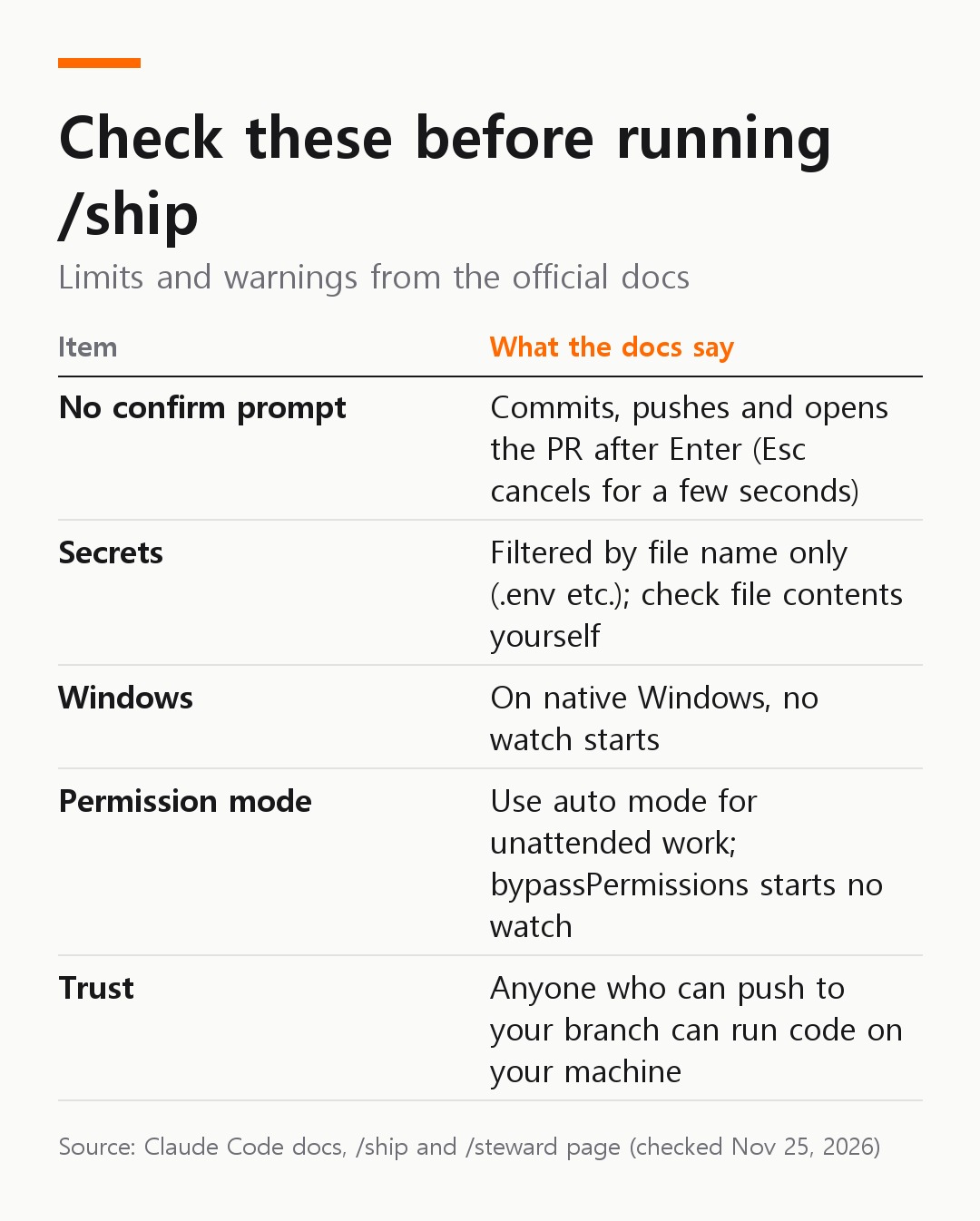
There is no confirmation prompt. After you press Enter, /ship can commit, push and open the PR. Before the commit and again before the push, a line ending in “Esc to cancel” appears, and if you do nothing it continues after a few seconds. If you cancel after a commit, the docs suggest git reset HEAD~1 to undo it and keep your files.
It can commit everything uncommitted. New files included. Run git status first and delete or stash anything that should not be in the PR. Secrets are detected by file name only (such as .env), so look inside your files yourself. A deny rule in your settings does not keep a file out of the commit.
No watch on native Windows. The docs state plainly that on native Windows no watch starts, and none starts in a background session either. Plan mode and bypassPermissions mode also prevent a watch. For unattended work the docs point to auto mode; in Manual or acceptEdits mode Claude waits at each prompt.
Trust everyone who can push. A watch uses your gh and git sign-ins, so its commits appear under your name. The docs warn that anyone who can merge to the base branch or push to your branch can run programs on your computer with your credentials, and recommend running a watch only where you trust all of them.
Auto-merge can skip people entirely. If you use GitHub auto-merge or a merge queue with a policy that does not require a person’s approval, a change can merge without anyone acting. The Claude Approvals check only blocks a merge where you make it a required check.
What Anthropic says it changed internally
Anthropic says that on the Claude Code team, where Claude’s review is one layer of a broader process, merged PRs more than doubled from June to September while the share of reverted PRs fell by more than 40%. These are the company’s own numbers, not an independent measurement.
How we checked
Everything above comes from pages we opened on November 25, 2026: Anthropic’s “Introducing Claude Ship” announcement, the Claude Ship product page, and the Claude Code documentation for Claude Ship, /ship and /steward, and /ship troubleshooting. We kept dated copies of those pages. Claude Ship is in beta, so commands, limits and pricing may differ after that date.
Official sources: Introducing Claude Ship · Get a pull request ready with /ship and /steward · Claude Ship documentation
Leave a Reply